
Disclosure: This article contains affiliate links, marked with *. If you make a purchase through one of these links, I may earn a commission. There is no additional cost to you. As an Amazon Associate, I earn from qualifying purchases.
You are browsing online or standing in a watch store, and the decision seems simple: the black watch with bright digits on a dark background simply looks “cooler.” But beware — G-Shock display readability is the exact point where community opinions split most dramatically. As is often the case, quick decisions aren’t always the best ones. In this comparison, we dissect the contrast of modern MIP displays, test positive and negative LCDs in real-world conditions, and show you which display is the right choice for your needs.
| Display Type | Sunlight Legibility | Low Light / Twilight | Viewing Angle | Verdict & Recommendation |
|---|---|---|---|---|
| MIP Display | Excellent (Pin-sharp) | Very Good (Requires LED) | Nearly 180° (Zero fading) | Pro Tip: Best legibility available, ideal for outdoor & sports. 👉 Check GBD-200 on Amazon* |
| Positive LCD | Very Good | Good | Moderate (Fades at steep angles) | Classic Choice: Proven all-rounder for daily wear and heritage models. |
| Negative LCD | Moderate to Poor | Poor (Very dark) | Restricted | Style Focus: Perfect for the stealth look, but weak in low light. |
The Three Factions of Time Display
1. The Positive Display: The Undisputed Champion
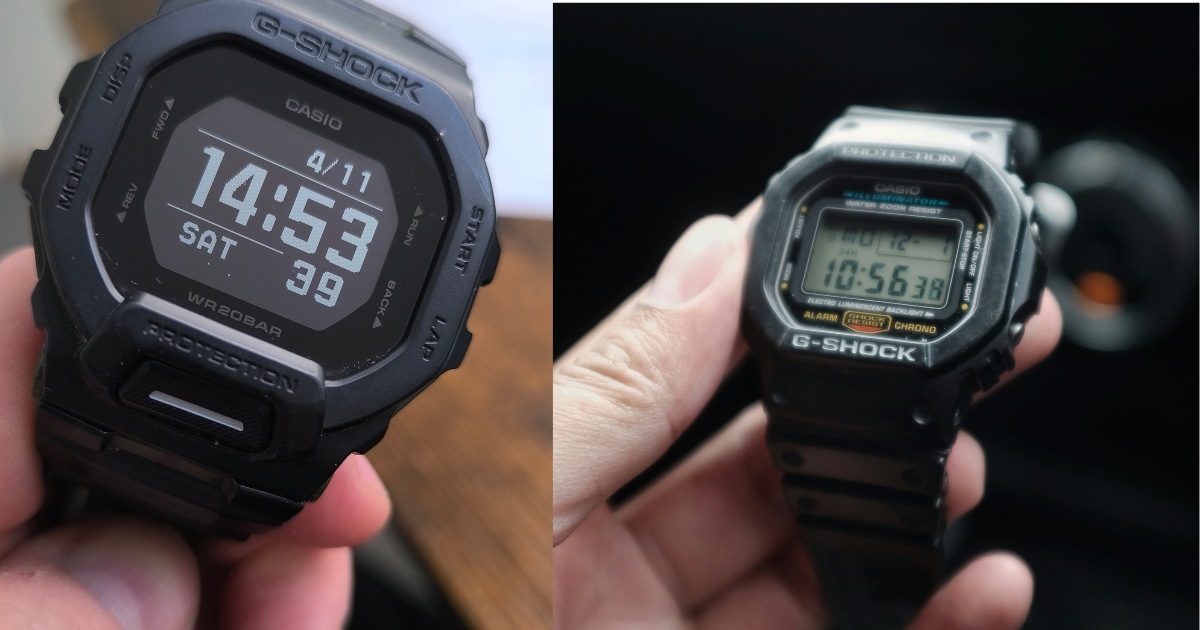
It is the display format that started it all back in 1983: black liquid crystal numbers on a light grey background.
- Why it wins: Natural contrast. Your eye doesn’t have to strain to capture the digits. Even in deep twilight, when other displays sink into darkness, the positive display still delivers a readable screen.
- The drawback: In terms of design, it often looks “old-fashioned” or less tactical. However, if you prioritize G-Shock display readability over aesthetics, you can’t go past a positive display (like on the GW-M5610U).
Practical Lighting Tip: On models like the GW-M5610U, look for the “U” designation in the name. Newer U-modules feature a bright, energy-efficient white LED backlight instead of the older blue EL backlight.
2. The Negative Display: Tactical, but Tricky
Bright digits on a black background. It is the epitome of G-Shock style — military, discreet, modern.
- The downside: Physics is working against you here. A negative LCD requires plenty of ambient light to generate contrast.
- STN Displays to the rescue: In high-end models, Casio installs “Super Twisted Nematic” displays. These drastically improve G-Shock display readability on negative models by providing wider viewing angles. However, it remains a compromise for the eyes.
Indoors or under overcast skies, you often have to tilt your wrist at a specific angle toward the light to read the time. Inverted segment displays lose significant contrast starting at just a 45° angle.
3. The MIP Display: The 2020s Revolution
“Memory in Pixel” (MIP) is the technology that changed everything. Popularized by the GBD-200, the DW-H5600, or models from the G-Shock Outdoor Series like the GPR-H1000 Rangeman.
There is no “washing out” of colors anymore, no matter how steep your viewing angle is. Stable up to 175° viewing angles — digits stay razor-sharp even at extreme wrist tilts.
- Advantages: MIP works similarly to E-Ink, but operates much faster (similar to Amazon Kindle screens). Contrast is phenomenal, looking almost as if the numbers are printed directly onto the glass.
- Power consumption & design: MIP allows high-resolution graphics and varied fonts. The catch? It consumes more power during fast animations (like running seconds), which is why MIP watches almost always require Tough Solar or larger batteries.
Choosing the Right Display for Your Lifestyle
If you use your watch as a true tool (military, emergency services, trades, outdoor), G-Shock display readability is essential. My advice: choose a MIP display or a classic positive display. If you’re a collector who wears the watch as a lifestyle accessory and doesn’t mind hitting the light button more often, the negative display is the sleeker choice.
Verdict: Which Display Suits You?
- Choose a MIP Display if you want uncompromising legibility from any angle and appreciate modern features (e.g., the G-Shock GBD-200 on Amazon*).
- Choose a Positive LCD if you love the original retro look and want a low-maintenance, bulletproof classic (e.g., the GW-M5610U on Amazon*).
- Choose a Negative LCD only if the stealth look is your top priority and everyday legibility is secondary.